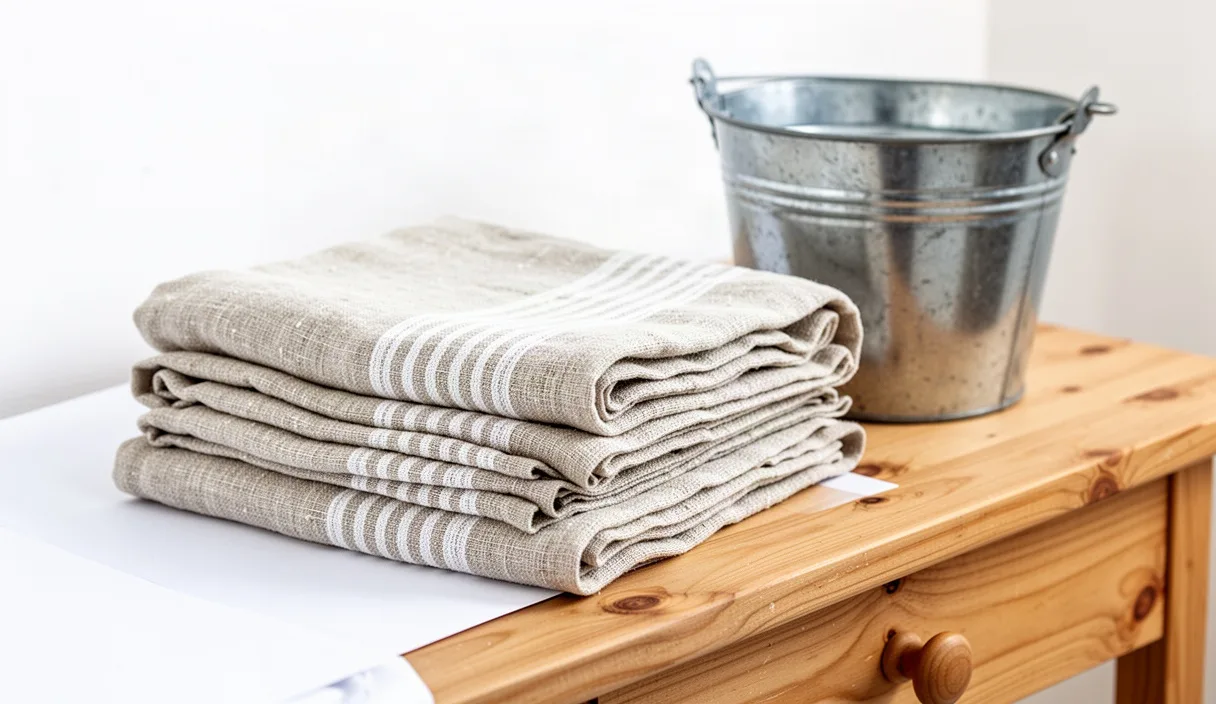
When we unpack a fresh bolt of heavy linen or unwrap a set of newly hemmed tea towels, they rarely resemble the buttery, supple cloths we reach for by instinct in the kitchen. Woven from unrefined flax fibers at substantial weights like 320 to 380 grams per square meter, new linen feels rigid, crisp, and almost papery. It resists folding and stands stiffly on the countertop. This tactile stiffness is not a flaw in the weaving process; it is the natural signature of raw bast fiber held together by plant pectins that have not yet been broken down through use and washing.
Bringing heavy linen into its proper working state requires patience and physical agitation rather than harsh chemical softening treatments. In our kitchen and workshop, we treat laundering not merely as a sanitation chore, but as the final stage of finishing the cloth. With every cycle through cool water, every snap on the clothesline, and every meal cleaned up, the internal fibers yield. Within a dozen washes, a dense linen towel transforms into an absorbent tool that outlasts ordinary cotton while developing a soft, rippled drape that sits comfortably in the hand.
The natural structure of flax versus commercial cotton
To understand why linen requires distinct care, we must look at how the flax plant builds its stalk. Linen is a bast fiber derived from the phloem tissue of Linum usitatissimum. These structural fibers grow in long, composite bundles running the entire length of the plant stem, bound together by calcium pectins, waxes, and lignin. In contrast, commercial cotton is a single-celled seed hair made almost entirely of pure, hollow cellulose that grows in soft, twisting ribbons. While cotton fibers measure roughly 20 to 35 millimeters in length, individual flax fiber cells reach 25 to 50 millimeters, bundled into multi-fiber strands that can measure up to 900 millimeters.
Because of this long, crystalline architecture, flax fibers possess twice the tensile strength of cotton, and that strength increases by roughly 18 percent when wet. However, this same crystalline rigidity gives fresh linen its unyielding initial hand. Each filament has a polygonal cross-section with a narrow central lumen, creating a firm structural tube. Cotton absorbs water quickly through capillary draw within its loose twists, but linen absorbs water directly into the cell walls themselves, swelling the fibers and dissolving residual plant gums over time.
| Property | Heavy Flax Linen | Commercial Ring-Spun Cotton |
|---|---|---|
| Fiber Origin | Bast bundle from plant stem | Seed hair boll |
| Average Cell Length | 25 to 50 mm (bundles up to 900 mm) | 20 to 35 mm |
| Wet Tensile Behavior | Strengthens significantly when wet | Weakens slightly or remains neutral |
| Cellulose Crystallinity | High (rigid, crystalline alignment) | Moderate (flexible, twisted ribbons) |
| Water Absorption Limit | Holds up to 22 percent moisture without feeling damp | Holds roughly 14 percent moisture before saturation |
As we wash linen, the mechanical flexion of the water combined with gentle friction separates the microscopic bundles of flax fibrils. The plant pectins gradually dissolve, and the smooth nodes along the flax filaments begin to hinge rather than snap. Cotton breaks down by fraying and losing short fibers as lint, which eventually thins the cloth. Linen instead sloughs off its microscopic surface resins, splitting into finer, softer fibrils while keeping its structural core intact.
Why conventional dryer sheets make towels repel liquid
Commercial laundry aids, particularly dryer sheets and liquid fabric softeners, work through chemical deposition rather than mechanical softening. These formulations rely on quaternary ammonium compounds, commonly known as quats, suspended in a base of emulsified animal fats or synthetic tallow derivatives. During the rinse or tumble-drying cycle, these positively charged surfactants bond electrostatically to the negatively charged surface of wet cellulose fibers, coating the textile in a thin, microscopic film of wax.
On clothing where drape and static reduction are the primary goals, this waxy layer creates an illusion of slipperiness. On a heavy kitchen towel, it is disastrous. The fatty molecules fill the open pores and narrow lumens of the flax nodes, sealing the hydrophilic sites where water molecules would normally bind to the cellulose chain. Instead of pulling water away from a wet cast-iron skillet or a freshly rinsed cabbage leaf, the treated linen causes moisture to bead on its surface and roll off. A single cycle with a dryer sheet can reduce a towel's immediate water uptake by more than 40 percent.
Over repeated washings, this residue accumulates, baking into the fibers through dryer heat and creating a rancid, water-resistant barrier that traps kitchen odors and grease deep inside the weave. To restore a towel compromised by commercial softeners, we must strip the wax using hot water washes paired with sodium carbonate (washing soda), which saponifies the fatty deposits so they can be rinsed clean.
Water temperature settings that protect woven hems
Water temperature controls both the rate of fiber relaxation and the shrinkage behavior of woven hems. Raw flax cloth can tolerate boiling water without losing structural integrity, which is why historic domestic linens were scalded in copper wash pots. However, modern tea towels are rarely constructed purely of unhemmed cloth. They feature turned edges sewn with commercial sewing thread, and this mixed construction dictates our wash temperature.
When heavy linen is soaked, the warp and weft yarns swell laterally and shrink longitudinally, causing the fabric to contract by 6 to 9 percent on its initial wash. If sewing thread, typically a mercerized cotton or cotton-covered polyester core, contracts at a different rate than the dense flax ground, the edges puckering into tight, irregular ruffles known as differential tension cockling. To prevent this distortion while still relaxing the thick yarns, we keep water temperatures steady between 30 and 40 degrees Celsius (86 to 104 degrees Fahrenheit).
- Initial laundering: Use a cool wash at 30 degrees Celsius with a long soak period to permit the dry flax fibers to hydrate slowly before mechanical agitation begins.
- Subsequent utility cycles: Run a standard cycle at 40 degrees Celsius for everyday kitchen grime, light oils, and flour dust.
- Stained cloths: Treat heavily soiled towels at 60 degrees Celsius only after several preliminary cool washes have stabilized the dimensions of the hem.
- Spin extraction: Limit the spin cycle to 600 or 800 revolutions per minute. High-speed extraction at 1200 or 1400 revolutions per minute crushes the wet hollow fibers against the drum wall, pressing permanent, chalky stress creases into the cloth that are nearly impossible to remove.
Using simple vinegar rinses to dissolve laundry soap residue
Linen is naturally prone to trapping mineral ions and detergent surfactants. In hard water areas where calcium and magnesium carbonates are present, soap reacts to form an insoluble curd that settles into the crevices of the thick flax yarns. This mineral accumulation leaves dry linen feeling scratchy, brittle, and gray. Because linen has an alkaline tolerance but can be dried out by alkaline salts left behind in the weave, restoring a soft hand requires neutralizing those deposits during the final rinse.
Standard household white distilled vinegar, which contains approximately 5 percent acetic acid, is ideal for this purpose. The mild acid converts insoluble calcium and magnesium carbonates into soluble acetates that wash away cleanly with the discharge water. Simultaneously, it strips lingering detergent salts, lowering the surface pH of the linen back to a balanced, skin-friendly range between 5.5 and 6.5.
- Measuring the acid: Pour 120 to 180 milliliters (roughly half to three-quarters of a cup) of plain 5 percent white vinegar directly into the fabric softener compartment of your washing machine drawer.
- Timing the dispense: Allow the machine to dispense the vinegar automatically during the final rinse cycle, ensuring it works through clean water rather than competing with active detergent suds.
- Manual basin rinsing: For hand laundering in a washbasin, submerge the washed and rinsed towels in a water bath containing 60 milliliters of vinegar per 10 liters of water, agitating the cloth by hand for three minutes before pressing out the excess liquid.
- Odor dissipation: Do not worry about lingering acidity. As the linen dries and the volatile acetic acid evaporates into the air, the faint vinegar scent disappears entirely, leaving behind only the earthy, hay-like aroma of clean flax.
Air-drying outdoors on a taut hemp clothesline
While an electric dryer tumbling on low heat can break fiber stiffness through continuous friction, nothing rivals outdoor line drying for developing the distinctive crisp-yet-supple body of heritage linen. Mechanical dryers subject thick flax hems to abrasive edge-wear and can break the delicate hair-like fibrils that form on the surface of the yarn, generating unnecessary lint. Outdoor air-drying preserves yarn density while harnessing atmospheric humidity and moving air to relax the weave.
We prefer a line braided from untreated hemp twine. Unlike slick nylon cords, natural hemp provides a textured grip that holds heavy, wet linen securely without requiring aggressive clamp pressure from clothespins. Furthermore, synthetic lines can transfer plasticizer residues to damp textiles under strong sunlight, whereas natural hemp breathes alongside the drying towels.
When hanging heavy linen, moisture gradient is your primary tool. Shake each towel vigorously three times while it is still damp to loosen the weave and realign the yarns. Pin the towel along its reinforced selvage rather than by the delicate turned hems, using smooth birch or beechwood spring pins. If the wind is brisk, the continuous billow and snap of the cloth works the fibers like a gentle domestic fulling mill, breaking down stiffness without scouring the surface. To protect naturally dyed or unbleached oatmeal flax from photo-bleaching, position the line in bright indirect light or under the broken shade of an orchard canopy rather than in harsh, direct midday sun.
Rolling rather than pressing to preserve rustic drape
Traditional domestic manuals often advise pressing damp linen under a heavy flatiron heated to maximum temperature. While hot pressing produces a glass-smooth, formal sheen suitable for banquet damasks, it destroys the casual, textured character of heavy kitchen towels. Ironing crushes the natural roundness of thick slub yarns, flattening them into ribbons and giving the cloth a boardy, unyielding stiffness that must be broken down all over again through manual use.
To preserve the textured surface and relaxed drape of artisanal linen, we turn to the cold-mangle principle through manual rolling. This historic method aligns the weave, smooths deep wrinkles, and keeps the internal spring of the bast fibers intact.
Begin when the towels are slightly damp, roughly 85 percent dry from the clothesline. If the towels have dried completely, mist them evenly with filtered water from a fine spray bottle and let them rest stacked beneath a clean flour sack for twenty minutes to achieve uniform hydration. Lay the towel flat on an unfinished wood or stone worktable. Smooth the surface outward from the center using the palms of your hands, squaring the corners and pulling gently along the hemmed edges to flatten any minor cockling.
Next, roll the towel tightly around a solid wooden cylinder, such as a clean 50-millimeter hardwood dowel or a heavy French rolling pin. Apply firm, downward pressure with your forearms as you roll, compressing the layers against the wood. Once rolled, leave the towel bound around the core with a strip of cotton tape for an hour, or slip the rolled cylinder off and lay the cloth roll horizontally in a drawer. As the last traces of moisture evaporate in this compressed state, the cellulose bonds settle into a smooth, supple curve without the artificial gloss or crisp brittleness caused by direct heat.
Common mistakes
- Overcrowding the wash drum: Flax fibers need ample water to swim freely. When crammed into a full drum, heavy linen rubs tightly against itself, creating permanent abrasion marks and white streak lines known as wash wear. Fill the machine drum no more than half full by dry volume.
- Using chlorine bleach: Chlorine oxidizes cellulose rapidly, dissolving the internal pectins too fast and causing the bast fibers to sever. This turns heavy linen brittle and results in premature holes along the fold lines. Use oxygen-based sodium percarbonate for brightening instead.
- Leaving damp linen folded: Wet bast fibers are prone to mildew when starved of air. Never leave damp towels bundled in a laundry basket overnight; hanging or rolling must begin immediately after the wash cycle ends.
- Excessive laundry powder: Dense weaves hold onto powdered detergents that do not fully dissolve in cool water. Always use a modest quantity of low-foaming liquid soap designed for natural fibers, using roughly half the manufacturer's suggested dose.
Next steps for your kitchen linen
To begin breaking in a set of stiff, unwashed linen towels, start with an overnight soak. Place the folded towels into a deep tub or basin filled with tepid water and let them rest submerged for eight to twelve hours without any detergent. This slow pre-soak fully saturates the crystalline cores of the flax fibers, relaxing the warp and weft tensions created during weaving and dramatically reducing initial shrinkage when the towels enter their first mechanical wash.
Following the soak, run the towels through a short wash at 30 degrees Celsius with a low spin speed, add 120 milliliters of white vinegar to the rinse, and carry them out to the line. Once you introduce them to your kitchen routine, rotate them through regular washings every four to five days. Heavy linen thrives on hard work: every cycle of drying pots, wiping down cutting boards, and catching flour beneath a bread bowl will bring your towels closer to the supple, heirloom quality that makes flax the finest kitchen textile in the world.