When we melt a block of cultured farm butter in an enamel pot, we witness the quiet unmaking of an emulsion. Dairy fat, water, and milk solids sit bound together inside cold butter, held in suspension by mechanical working during the churning process. As thermal energy enters through the thick base of the vessel, that mechanical bond loosens. The components untangle themselves according to their natural densities, dividing what was once a solid spread into three visible strata.
Standard retail butter contains between 80 and 84 percent butterfat, alongside roughly 16 percent water and two percent milk solids consisting of proteins, lactose, and mineral salts. Those solids burn at roughly 300 degrees Fahrenheit, producing bitter acrid compounds and smoking out a kitchen during high-heat cooking. By separating and discarding the moisture and solids, we extract the pure triglycerides. The resulting oil withstands pan temperatures exceeding 450 degrees Fahrenheit, lending itself to dry searing, basting, and long-term keeping in a dark pantry.
The three distinct layers of melting farm butter
To clarify butter with precision, we must track the physical separation as it occurs in real time. Setting two pounds of unsalted, high-fat cultured butter into a heavy three-quart saucier reveals this partition over twelve to fifteen minutes. The butter slumps against the warm metal, foaming initially as trapped air escapes. As the internal heat reaches 185 degrees Fahrenheit, the mixture resolves into three distinct horizontal zones, each behaving differently under heat.
The uppermost layer appears as a pale, chalky crust. This white froth consists mostly of light whey proteins, specifically beta-lactoglobulin and alpha-lactalbumin, brought to the surface on tiny bubbles of evaporating steam. It forms a brittle honeycomb structure across the liquid. Left undisturbed, this foam acts as a blanket, trapping residual humidity beneath it and preventing clean evaporation.
Beneath this frothy crown sits the prize: the clarified butterfat. It displays a radiant, translucent amber or deep golden-yellow tint, depending on whether the cows grazed on fresh spring grasses rich in beta-carotene or dry winter silage. In this middle band, the liquid runs thin and clear, free of cloudiness when held against the light of a window.
The bottom layer holds the heavy fraction. Water-dense and protein-rich, these solids are primarily caseins along with lactose and residual moisture. They sink to the absolute floor of the pan, forming a cloudy, off-white sediment that looks like loose curds. Because this sediment rests in direct contact with the conductive base of the cookware, it remains the most vulnerable part of the whole system.
| Layer | Primary Composition | Behavior Under Heat | Handling Method |
|---|---|---|---|
| Top Crust | Whey proteins, trapped air bubbles | Dries into a crisp, delicate foam | Skim carefully with an offset spoon |
| Middle Fluid | Pure milk fat (lipids) | Clears completely, retains heat well | Decant and filter through cloth |
| Bottom Sludge | Casein solids, lactose, residual water | Prone to rapid scorching and sticking | Leave behind at the bottom of the pan |
Controlling flame height to prevent browning the whey
Traditional French clarified butter demands zero coloration, which separates it technically from South Asian ghee or French beurre noisette. When our objective is raw cooking stability and pure, sweet fat, allowing the bottom caseins to brown is an error. The Maillard reaction, occurring when milk sugars bind with amino acids under heat, creates nutty toasted aromas that lower the smoke tolerance of the finished fat and alter the pure clean dairy finish we want for searing delicate cuts.
We keep the heat source dialled to a steady, modest simmer. On an open gas burner, this translates to a flame ring no wider than two silver dollars, positioned dead center beneath the pan. If cooking on an induction plate, an operational setting between 190 and 205 degrees Fahrenheit keeps the liquid active without throwing the solids into turbulence. If the flame licks up the curved sides of the pot, the thin film of butter clinging to the perimeter will scorch long before the interior mass has finished driving off its water.
Listen closely to the sound of the saucier. In the initial twenty minutes, the pan chatters with a brisk, irregular popping. That sound is water boiling off: liquid droplets meeting the pan floor, vaporizing, and bursting up through the lipid layer. As long as that wet popping continues, the internal temperature of the water remains pegged near 212 degrees Fahrenheit, which protects the caseins from climbing into browning territory. When the popping subsides into a quiet, uniform hiss, the moisture is largely gone, and the risk of scorching multiplies tenfold.
Skimming surface foam with an offset spoon
Once the butter holds a gentle simmer, the surface crust thickens and breaks into drifting islands. To remove this whey cap without agitating the sediment down below, we use a wide, shallow utensil. An offset saucier spoon or a broad, thin-lipped tasting spoon provides better tactile control than a deep ladle. A deep ladle creates a downward draft in the liquid that pulls surface curd into the middle fat layer.
We work in concentric circles around the rim of the pot. Skim just beneath the crust, drawing the spoon toward the center in broad, shallow strokes:
- Rest the heel of the spoon lightly against the liquid surface, using surface tension to draw the foam onto the metal.
- Transfer the collected whey foam into a ceramic ramekin after every two passes. Avoid tapping the spoon on the pan rim, which shatters the foam crust back into fine flakes.
- Reserve this skimmed whey foam in the refrigerator; it carries rich flavor and can be stirred into hot morning oatmeal or brushed over raw bread dough before baking.
- Continue skimming every four to five minutes until the surface mirrors the room, with only sparse pinpricks of clear bubbles breaking through the oil.
Take your time with this manual clearance. Rushing the skimming by vigorously dragging a large spoon through the liquid will disturb the bottom layer. If the casein sediment stirs up into the fat, you will lose the clean clarity of the batch and lengthen the time required for passive settling.
Filtering through fine linen into clean glassware
Even the steadiest hand leaves behind rogue particles of whey on the surface and risks drawing loose caseins during decanting. A physical filtration barrier is mandatory. Paper coffee filters are often recommended, but their tight cellulose weaves plug within seconds as cold fat clogs their pores, forcing you to reheat the oil repeatedly or wait hours for a trickle. Instead, we use unbleached linen or multi-layered butter muslin.
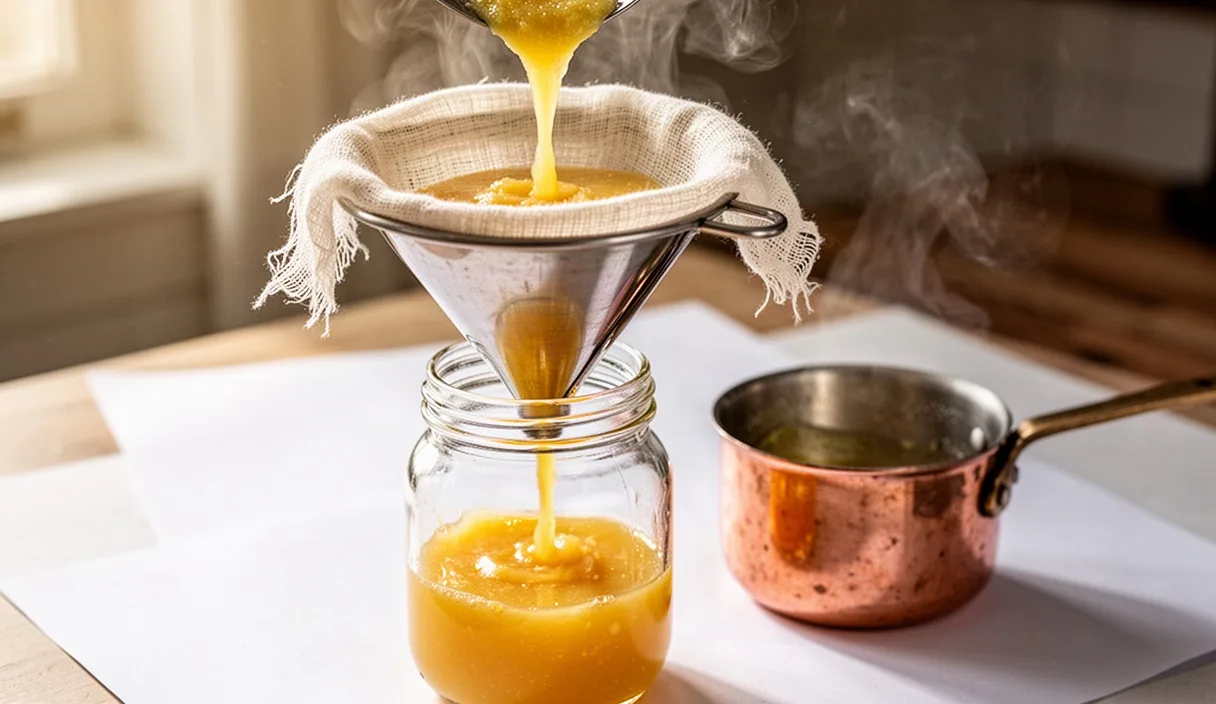
Cut a square of heavy linen, roughly ten inches across, and scald it in boiling water. Wring it bone dry until it feels barely cool to the touch. This hot-water pre-soak washes away loose textile lint and preheats the cloth fibers so they do not shock the passing butterfat into a thick wax. Drape this cloth into a wide stainless-steel funnel seated securely inside a pre-warmed, dry glass mason jar. If the glass is cold from a winter larder, pouring fat at 220 degrees Fahrenheit into it can cause thermal shock and crack the vessel.
Take the saucier off the flame and let it sit on a wood cutting board for three full minutes. This quiet rest allows any agitated casein particles to drop like silt to the metal bottom. Tilt the pan slowly, pouring the liquid in a steady pencil-thin stream directly onto the center of the linen. Watch the bottom of the saucier closely. Stop pouring the instant the white, milk-heavy sediment creeps within two inches of the pan lip. Discard that sludge, or tip it into a bowl for quick pan-basting of roasted root vegetables that same evening.
Signs of complete moisture removal for shelf storage
The primary enemy of shelf-stable butterfat is not air or light, but residual moisture. Bacteria and fungi cannot replicate in pure lipid environments; they require accessible water to metabolize. If you leave even a quarter of a teaspoon of moisture in a quart of clarified fat, it settles into an invisible droplet pool at the base of the jar, turning sour or fuzzy within three weeks at room temperature.
We monitor three sensory markers to guarantee the oil is completely anhydrous before sealing the glass:
- Acoustic cessation: The boiling, snapping sound in the pan stops entirely. The liquid goes almost silent, emitting only a faint rustle of dry heat.
- Visual optical clarity: The liquid is transparent. Looking down through four inches of hot fat in the pan, the rivet heads on the handle or the stamped logo on the interior floor should be readable without blur or milky hazing.
- The cold steel test: Take a cold, completely dry stainless steel butter knife and plunge the blade into the hot fat for three seconds. Draw it out into the ambient room air. If steam rises off the blade or if tiny droplets condense on the metal flat, water remains in the fat. If the knife shows only a clean sheen of liquid oil that slowly sets into an amber glaze, the moisture is entirely gone.
Once poured and cooled to room temperature, properly clarified butter sets into an opaque, pale buttercup-yellow paste with a smooth, micro-crystalline grain. When sealed inside clean jars away from direct sunlight, it keeps on a cool kitchen shelf for six to nine months, or in a cold pantry for over a year without going rancid.
Pairing high-heat clarified fat with cast iron searing
The primary kitchen benefit of pure butterfat is its functional cooking threshold. Standard butter smokes at approximately 300 to 350 degrees Fahrenheit as its sugars scorch. Clarified fat comfortably holds until 450 to 465 degrees Fahrenheit. This makes it an ideal medium for well-seasoned cast iron or carbon steel pans, which demand high surface temperatures to produce a deeply caramelized, savory crust on proteins.
When searing a thick cut of meat, such as a dry-aged strip steak or pork loin, vegetable oils like canola or refined soybean provide heat tolerance but offer a neutral, occasionally metallic aftertaste. Clarified butter provides that same thermal resilience while carrying the rich, rounded aroma of dairy fat. Because it contains no water, it does not pop violently or spatter hot water-droplets onto your arms when it contacts hot cast iron.
Warm your skillet slowly over a low burner for seven to eight minutes, allowing the heavy iron to soak up heat uniformly across its entire mass. Bring the pan surface to roughly 425 degrees Fahrenheit. Spoon two tablespoons of clarified fat into the center. The fat should spread instantly without scorching, flashing, or smoking. Lay the dry protein directly into the shimmering fat. The absence of water ensures immediate contact between the meat fibers and the iron face, triggering rapid caramelization without boiling the surface in trapped steam.
Common mistakes
Even a simple method has small points of failure where attention wanders. We regularly see three specific missteps that compromise the batch:
- Stirring the pot: Resist the urge to sweep a spatula across the bottom of the pan while the butter melts. Stirring recombines the rising whey with the falling casein, clouding the middle fat layer and making mechanical separation far more difficult.
- Leaving the heat unattended: The transition between water evaporation and casein burning takes less than two minutes. Once the popping stops, the fat temperature climbs rapidly. If left alone, the bottom sediment will toast, brown, and impart unwanted bitterness to the batch.
- Sealing the jars while hot: Screwing a metal lid tightly onto a jar of warm clarified fat traps the rising vapor inside the headspace. That steam condenses on the underside of the lid and drips back down into the cooling fat, reintroducing the exact water you spent thirty minutes removing. Let jars cool completely on the counter under a dry lint-free tea towel before capping them.
Next steps for the kitchen bench
To begin stocking your pantry, start with two pounds of butter. Working with less than that amount is frustrating, as smaller volumes lose heat too quickly and evaporate their water before the stratification lines stabilize in the saucier. Choose unsalted butter made from pasture-raised cream whenever possible; salted butter concentrates its salinity during evaporation, yielding an unpleasantly sharp fat that limits how you can season your cooking later.
Inspect your storage vessels before turning on the stove. Wash two pint-sized canning jars in hot soapy water, rinse them thoroughly, and dry them in a 200-degree-Fahrenheit oven for fifteen minutes to eliminate lingering moisture. Lay out your offset spoon, a heat-safe funnel, and a clean scrap of dense linen on a clean cutting board. With your tools arranged and your heat source low and steady, melting down fat becomes one of the most rewarding, rhythmic preserving rituals in a maker's kitchen.