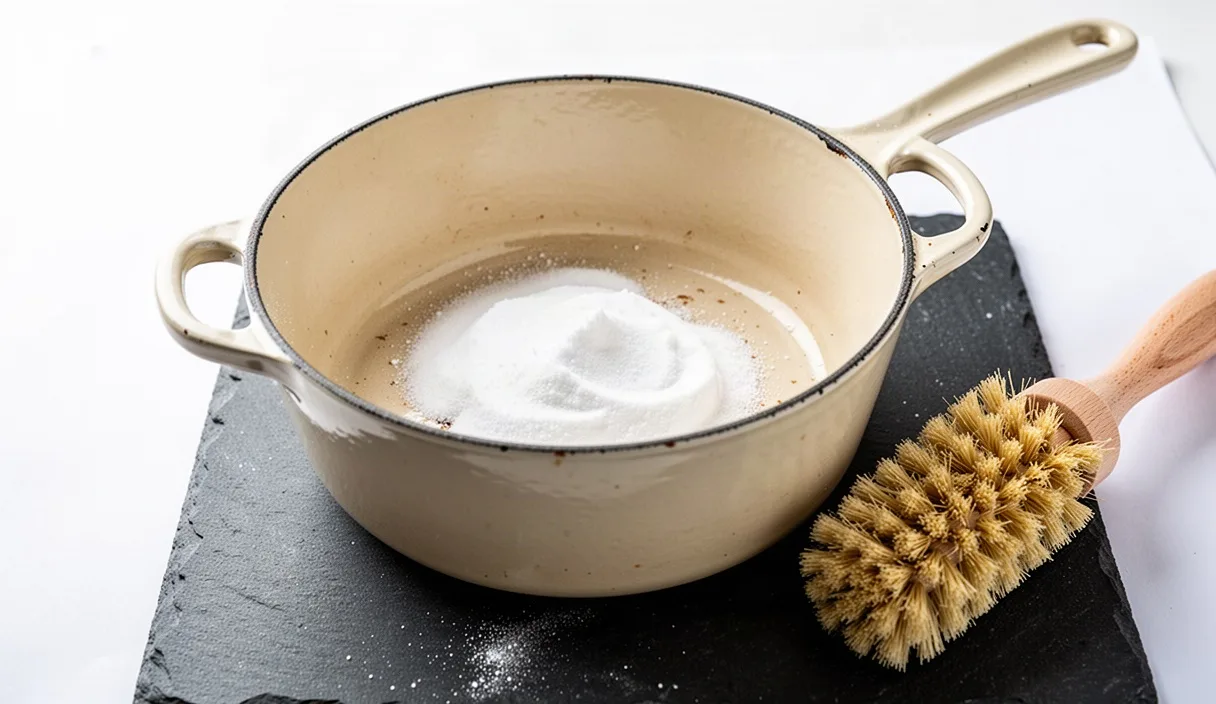
When we lift a heavy Dutch oven from the stove, we hold several centuries of metallurgical refinement in our hands. The dense core of cast iron anchors heat, while the smooth skin of vitreous enamel provides an inert, non-reactive vessel for slow braises, acidic fruit preserves, and long simmers. Over months of steady kitchen service, this pale cooking surface records our work. Caramelized sugars leave dark shadows, hard well water deposits a chalky calcium film, and stray moisture finds the vulnerable cast seam at the rim, producing an orange haze of rust.
Restoring this surface requires an understanding of how glass and iron interact under heat and chemical exposure. Enamel is not a synthetic non-stick film that can peel off in sheets, nor is it bare metal that can be scoured back to raw alloy with steel scrubbers. It is a thin sheet of glass melted directly onto a rough casting. To lift charred pan drippings and dissolved mineral crusts without scouring away the shine, we turn to simple alkaline baths, soft wood scrapers, and plain baking soda.
The delicate nature of fired glass on heavy iron
Vitreous enamel begins as frit, a powdered glass compound composed of silica, feldspar, borax, and mineral oxides for pigment. Foundries spray or dip this dry or wet slurry onto raw, cleaned iron castings that have been tumbled to remove casting sand. The pot enters an industrial furnace heated between 780 and 850 degrees Celsius. At this temperature, the iron glows cherry red and the frit melts into a liquid glaze, flowing into the microscopic pores and crevices of the cast iron body. As the piece cools, the glass hardens, forming a mechanical and chemical bond with the substrate.
Because glass and iron have different thermal expansion coefficients, foundries carefully formulate the frit so both materials expand and contract at nearly identical rates. Even so, the bonded glass remains brittle and holds internal tension. When iron expands suddenly under high heat, the rigid glass shell must stretch with it. Sudden local heating or dropping the pot onto a stone counter creates micro-fractures in the glass layer. Once these hairline fissures appear, liquids seep through to the bare iron beneath, lifting the glass from below and causing it to spall or flake away in sharp flakes.
Understanding this structure alters how we clean the vessel. Chemical attack from caustic lyes or coarse abrasives attacks the surface sheen of the glaze. When the gloss dulls, the microscopic profile of the glass becomes rough and porous, grabbing hold of proteins and starches during cooking. Every cleaning method we choose must respect the fact that we are washing a hand-cast piece of plate glass fused to a heavy metal anvil.
Why wire wool permanently ruins glossy enamel surfaces
Faced with a pot coated in blackened meat juices, the temptation is to reach for a brass pad, wire wool, or a green synthetic scouring sheet. These tools solve the problem in thirty seconds by gouging away the charred residue along with several microns of fired glass. Fired enamel registers around 5 to 6 on the Mohs scale of mineral hardness. Coarse carbon steel, hardened wire pads, and aluminum oxide scouring sponges sit higher on that scale, meaning they cut microscopic trenches across the smooth glass plane.
The damage from wire pads is cumulative and permanent. The first pass leaves faint grey streaks that cannot be washed away; these are traces of metal rubbed off into micro-scratches. Subsequent passes tear open the sealed fire-polished surface, leaving a matte finish that resembles ground chalk. Once the finish becomes matte, foods stick ten times more readily because proteins lodge in the newly opened valleys of the scratched glass. No seasoning technique can fix damaged enamel; unlike bare iron, glass cannot rebuild a polymerized patina.
| Tool or Cleaner | Mohs Hardness | Effect on Gloss Enamel |
|---|---|---|
| Sodium bicarbonate (baking soda) | 2.5 | Safely polishes without scratching glass |
| Hardwood scraper (beech or maple) | 2.0 to 3.0 | Lifts burnt crust through sheer lateral pressure |
| Copper mesh scrubber | 3.0 | Leaves metal drag marks; use with extreme caution |
| Standard wire wool (carbon steel) | 4.5 to 5.5 | Dulls gloss, creates microscopic gouges |
| Green synthetic scour pad (aluminum oxide) | 8.0 to 9.0 | Severely abrades and removes vitreous finish |
Preserving the factory finish requires soft materials paired with chemistry. Sodium bicarbonate sits at 2.5 on the Mohs scale, which is softer than enamel glass but harder than dried food soils, starches, and chalky limescale. It acts as an abrasive that breaks down under its own friction, rounding out its edges rather than cutting into the glass substrate.
Simmering a soda bath to break stubborn fond
When cooking preserves or searing short ribs leaves a stubborn, resinous crust across the base of the pot, brute physical force is the wrong response. We let thermal energy and mild alkalinity do the work of breaking down baked-on fats. Sodium bicarbonate dissolved in water forms a mildly alkaline solution with a pH around 8.3 to 8.5. When heated, bicarbonate begins to convert to sodium carbonate, which increases the pH to roughly 9.5. This alkaline bath saponifies hardened animal fats and vegetable oils, converting sticky grease into water-soluble soaps.
Begin by allowing the pot to cool to room temperature on a wooden board or trivet. Pouring cold liquid into a hot enameled pot will craze the glass immediately through thermal shock. Once the iron is lukewarm to the touch, follow these steps to dissolve the fond:
- Pour enough clean water into the pot to submerge the burnt zone by at least two centimeters.
- Sprinkle three generous tablespoons of baking soda across the water, stirring gently with a wooden spoon until the white powder dissolves into a cloudy liquid.
- Set the pot over low to medium heat on the stovetop. Bring the liquid to a slow, rolling simmer. Do not boil it violently, as bubbling water can dry out the sidewalls.
- Allow the mixture to simmer for fifteen to twenty minutes. As the alkaline solution works, you will notice the water turning dark amber as caramelized proteins detach from the floor of the pot.
- Use the flat edge of your wooden spoon to lightly prod the softened deposits. They will slide away in soft sheets without requiring heavy downward pressure.
- Turn off the heat, let the liquid cool until it is safe to touch, pour it down the drain, and wash the cavity with warm water and a soft cloth.
Working a paste into corner stains with wooden tools
After the loose fond is poured away, older pots often display gray-brown rings along the internal bottom radius where the horizontal floor turns upward into the vertical wall. This cove area receives less direct agitation from flat spoons during cooking and cleaning, making it a trap for burned fats and hard water minerals. Because heat alone cannot always loosen this thin, highly compressed scale, we switch to a low-moisture paste.
Mix three parts baking soda with one part lukewarm tap water in a small ceramic bowl until it reaches the consistency of dense mortar. If the paste is too runny, it will wash around the pot without offering resistance; if it is too dry, it will crumble into dry dust. Spread this mixture directly onto the stained corner radius with your fingers, covering the discoloration in a blanket three millimeters thick. Allow the paste to rest on the stain for thirty minutes so the alkaline moisture can penetrate the calcified layer.
To provide mechanical scrub without scratching, select a wooden kitchen spatula with a sharp, straight front edge. Avoid rounded spoons, which concentrate force on a single pinpoint. Hold the wooden edge at a forty-five degree angle against the enamel floor and draw it along the internal perimeter, using short, overlapping strokes. The soft wood conforms slightly to the profile of the cast iron, pressing the baking soda crystals directly into the scale. Rinse the corner with clean water every minute or two to monitor your progress, reapply fresh paste as needed, and repeat until the pale, luminous base color returns.
Drying the unglazed rim to stop perimeter rust
Most enameled cast iron vessels feature an unglazed dark rim along the lip of the pot and the matching edge of the lid. During the manufacturing process, pots are often hung from metal racks by their rims or ground flat after the primary firing to ensure the lid sits true without rocking. This exposed band is raw cast iron, sometimes treated with a thin matte transit sealant, but fundamentally vulnerable to oxidation.
Perimeter rust occurs when wash water settles along this ground lip. Iron oxidizes rapidly in the presence of oxygen and standing moisture, throwing off soft, powdery iron oxide within hours. If left neglected, this rust can expand underneath the adjacent enamel border. Because iron oxide occupies more volume than raw cast iron, the swelling metal exerts outward hydraulic pressure, fracturing the glass edge and causing enamel to flake away from the rim in long, jagged lines.
To eliminate rim rust and prevent its return, follow this drying and sealing routine every time the pot meets water:
- Wipe the wet pot immediately after washing with a clean, lint-free cotton flour sack towel. Pay special attention to the deep groove beneath the lid rim and the unglazed ledge of the pot.
- Place the empty pot and its lid on the stovetop over the lowest flame or burner setting for three minutes. The radiant warmth will drive off invisible moisture trapped in the rough, porous surface of the exposed iron.
- Allow the rim to cool until comfortable to handle, then dispense two drops of neutral vegetable oil, such as grapeseed or refined canola oil, onto a strip of paper towel.
- Rub the oiled paper towel firmly along the dark rim of both the pot and lid, leaving a microscopically thin barrier that repels ambient air without feeling sticky.
Storing lidded pots with air gaps to prevent stale moisture
A closed enameled pot is an airtight chamber. When we seal a clean, dry pot with its heavy cast lid and stow it inside a dark kitchen cabinet, trace moisture remaining in the microscopic pores of the iron and enamel becomes trapped. Temperature drops in the pantry cause this trapped humid air to condense on the ceiling of the lid. The droplets run down to the rim, where they pool on the raw iron lip, generating rust rings while the vessel sits idle between meals.
The solution is simple mechanical ventilation. When storing these vessels, never place the lid directly onto the pot rim without an air gap. Most reputable makers ship their cookware with small, clear plastic spacers designed to slip over the rim. If you have discarded these, you can fabricate safe alternatives from scraps found around the workshop or home.
Cut three short segments of natural cork, dense felt, or cotton sash cord, each about two centimeters long. Space these items evenly around the pot rim before lowering the lid into place. This small gap of two to three millimeters allows air to circulate freely into the interior of the vessel, equalizing internal humidity with the room and preventing stale odors from lingering in the enamel cavity. If cabinet shelf space is limited, you may also store the lid upside down inside the pot mouth, provided you place a thick tea towel or folded linen between the enamel surfaces to prevent metal-on-glass chipping.
Common mistakes
Even conscientious cooks can accidentally damage vitreous enamel by misjudging the material properties of fused glass. Here are the practices to avoid:
- Shocking the base with cold tap water: Placing a hot pot directly into a sink filled with cold water causes sudden thermal contraction. The iron base shrinks faster than the glass glaze, causing the enamel to crack across the center in a distinct spiderweb pattern known as crazing.
- Scouring with dry baking soda on dry enamel: Always introduce a splash of water. Dry baking soda dragged across dry glass with a cloth creates unnecessarily harsh micro-scuffing that slowly grinds down the protective gloss finish.
- Mixing baking soda with distilled vinegar: While social media cleaning trends favor the violent fizz of this combination, chemically the acetic acid and sodium bicarbonate neutralize one another, producing water, carbon dioxide gas, and sodium acetate. The acid destroys the alkaline cleaning power of the bicarbonate, reducing the solution to salty water. Use the alkaline soda first, rinse thoroughly, and only then use a mild acid if mineral scale persists.
- Using oven cleaner indiscriminately: Heavy-duty commercial oven sprays rely on sodium hydroxide (lye). While lye strips carbonized grease, prolonged exposure or high temperatures can etch vitreous enamel glazes, turning bright colors cloudy and rough. If you must use chemical lye cleaners, reserve them as an absolute last resort and consult the manufacturer instructions beforehand.
Taking care of your pots over time
Enameled cast iron rewards patient, attentive maintenance over decades of honest kitchen work. The routine is not complicated, but it asks us to slow down. After each meal, let the vessel breathe and cool before offering it water. Look closely at the pale floor of the pot; if you see faint golden halos from roasting, treat them promptly with a warm soda bath rather than letting them bake into hard carbon over successive firings.
Examine the rim of your cookware every few months. If your thumb catches on a rough, rusty spot, polish it away immediately with a dab of baking soda paste on a dry cork, wipe it bone dry, and restore the oil seal. Cookware made this well does not wear out from regular use, but from hasty cleaning. Treat the fired glass as you would a delicate window, treat the iron beneath as the steady thermal engine it is, and your pots will continue to simmer broths and bake loaves for generations to come.